Beyond the Blueprint: What a Custom Home Actually Buys You Over Time
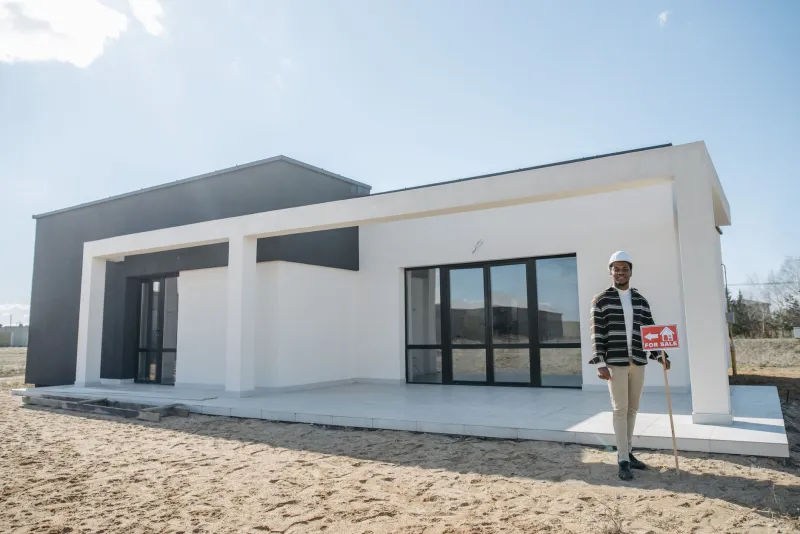
There is a persistent assumption embedded in American residential real estate: that a house is essentially a commodity. Square footage, bedroom count, zip code — these are the variables that matter, and the design itself is largely interchangeable. Walk through any new development on the outskirts of Phoenix, Charlotte, or Columbus, and the evidence seems to confirm it. The floor plans repeat. The elevations are shuffled and reused. The materials are selected not for longevity but for margin.
This assumption is costing homeowners more than most realize.
The gap between a custom-designed residence and a production-built home is not merely aesthetic. It is structural, financial, and deeply personal — and over the life of a home, that gap compounds in ways that rarely appear in a developer's marketing brochure.
The True Price of Standardization
Tract housing succeeds at one thing with impressive efficiency: reducing cost at the point of construction. Builders achieve this through volume purchasing, repeated labor sequences, and design templates that eliminate variation. The result is a product that can be delivered quickly and priced competitively on the day of sale.
What that model cannot account for is the household that occupies the home. Every family has a distinct rhythm — how they move through space in the morning, where natural light matters most, whether they need a quiet workspace, how they entertain, how they age. A floor plan designed to appeal to the broadest possible buyer pool is, by definition, optimized for no one in particular.
The consequences are practical. Rooms go unused. Traffic patterns create friction. Storage is never quite where it is needed. Homeowners begin renovating within a few years of purchase, attempting to retrofit a generic shell into something that actually fits their lives. According to data from the Joint Center for Housing Studies at Harvard University, American homeowners collectively spend over $400 billion annually on improvements and repairs — a significant portion of which addresses the original shortcomings of the home rather than genuine wear.
Appreciation and the Architecture Premium
Custom homes tend to hold and grow their value differently than production homes, particularly in markets where design literacy among buyers is increasing. A well-executed custom residence — one with considered proportions, quality material selections, and spatial logic that flows — stands apart in any comparative market analysis.
Real estate professionals in high-demand urban and suburban markets consistently report that homes with distinctive, architect-designed features command premium pricing at resale. This is not simply a function of luxury finishes. It reflects something more fundamental: a building that was designed as a whole, rather than assembled from a catalog of standard components, reads differently to buyers. It holds attention. It photographs well. It inspires offers.
In contrast, production homes in the same neighborhood often compete directly against one another at resale, their values tethered to the lowest common denominator of the development. When the market softens, generic inventory is the first to stall.
Energy Performance: Where Design Becomes Economics
Perhaps the most quantifiable argument for custom residential design lies in energy performance. A home designed with its specific site in mind — its orientation relative to the sun, the prevailing wind patterns, the local climate zone — can dramatically reduce mechanical heating and cooling loads through passive means alone.
Production homes are oriented to the grid of a subdivision, not to the path of the sun. Windows are placed for curb appeal, not for solar gain or cross-ventilation. Insulation values meet code minimums. The result is a home that works against its environment rather than with it, demanding consistent energy expenditure to remain comfortable.
A custom home designed with passive solar principles, proper window-to-wall ratios, and thermally appropriate envelope assemblies can reduce annual energy costs by 30 to 50 percent compared to a comparable production home. Over a 30-year mortgage, that differential represents tens of thousands of dollars — money that the homeowner retains rather than surrenders to utility providers.
At Adam Schiller Architect, site analysis is treated as foundational work, not an afterthought. Understanding how light moves across a property, where shade falls in summer, and how air circulates through a given landscape directly informs every design decision that follows.
Durability and the Long View
Custom residential design also permits meaningful choices about material quality and building longevity. Production builders select materials through a cost-optimization lens that favors initial price over service life. Composite siding, engineered flooring, and prefabricated cabinetry can all perform adequately in the short term — but they are not designed to endure decades of use with grace.
A custom home designed with long-term stewardship in mind incorporates materials selected for their performance over time: properly detailed masonry, solid wood millwork, roofing systems with 50-year warranties, mechanical equipment sized correctly for the actual load. These choices increase the upfront cost modestly while dramatically reducing the frequency and expense of replacement cycles.
The math is straightforward. A roof replaced twice over 40 years costs more than a roof replaced once. A window system that fails its thermal seal in 15 years costs more, cumulatively, than one specified to perform for 30. Quality, when selected with intention, is rarely the more expensive option over time.
Livability as a Return on Investment
There is a dimension of custom residential architecture that resists easy quantification but deserves acknowledgment: the daily experience of living in a home that was designed for you.
Research on environmental psychology consistently demonstrates that spatial quality affects mood, productivity, sleep, and social connection. The height of a ceiling, the quality of natural light in a kitchen, the acoustic separation between a home office and a living area — these variables are not luxuries. They are the conditions under which a household functions.
A home that supports its occupants' lives well tends to be cared for with greater attention. It is maintained more diligently, renovated more thoughtfully, and held longer. That relationship between resident and residence has tangible economic consequences: homes that are loved tend to be better preserved, and better-preserved homes retain value.
Rethinking the Initial Equation
The objection to custom residential design almost always centers on upfront cost. And it is true that a thoughtfully designed custom home will typically require a higher initial investment than a comparable production-built alternative. The architectural fee, the more deliberate material selections, the longer design and permitting process — these are real costs.
But they are costs that must be evaluated against the full arc of ownership: the energy savings, the reduced renovation expenditure, the resale premium, and the quality of daily life that a well-designed home provides. When that complete picture is considered, the calculus shifts considerably.
The question worth asking is not whether you can afford a custom-designed home. It is whether, over the span of decades, you can afford not to have one.